
Library
Alexander the Great -- the Conquests as a source of knowledge
The Founding of the Library and the Mouseion
The Egyptian Section of the Alexandria Library
The Papyri: Evidence of Greek and Egyptian Scientific Interchange
The Pinakes -- a Bibliographical Survey of the Alexandria Library
The Alexandria Library -- " The Memory of Mankind"
Appendix 1 -- The Contents of the Alexandria Library
Appendix 2 -- The End of the Library
References
The Modern
Library
BIBLIOTHECA ALEXANDRINA--The revival of the Ancient Library of Alexandria
Back to Alexandria Home Page
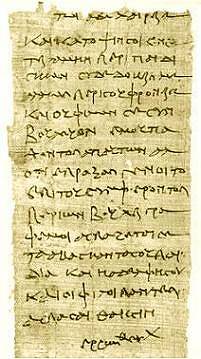 The Greek Hibeh papyrus no.27 which dates from 301-298 BC., has as its main subject, a detailed calendar from the Saite nome in the Delta; and it is prefaced by an introduction, presumably in the epistolary form, in which the compiler informs us that he "spent five years in the Saite as disciple to a wise man from whom he learned a great deal."
He goes on to say that the wise man explained and indicated all the facts in practice, with the use of a cylindrical stone instrument which Hellenes call "gnomon". Furthermore, the wise man expounded that the sun had two courses, one dividing night and day and the other winter and summer.
At this point the compiler adds a remark on the method with which astronomers and sacred scribes (Hierogrammateis) could fix the setting and rising of the stars and thereby could keep most of the festivals annually on the same day without alteration.
There is little doubt but that the wise man referred to was an Egyptian priest versed in astronomy. Furthermore, the identification in the text of the Greek word 'gnomon' with the Egyptian stone instrument for the measuring of time, is an indication that translation into Greek was active at the time of the founding of the Library.7
One might add that similarities between parts of the Hibeh papyrus and an astronomical treatise known as "Ars Eudoxi" which has survived in Papyrus de Paris no.1 (of the 2nd century BC.), suggest that both were derived from a much older prototype.
In addition, we know of a Ramesside calendar8 that has survived in a hieratic papyrus which employs the same system for measuring time on the basis of an equinoctial hour (of a constant duration), there is reason, therefore, to believe that the Ars Eudoxi and the Saite calendar were following an old Egyptian tradition.
Photo: A private letter from Oxyrhynchus